For most professionals, clothes are a private choice. For actors, clothes are part of the work. Every appearance, from the first casting audition through the press junket to the red carpet premiere, is being watched, photographed and analysed. The wardrobe becomes part of the public identity, and over the course of a career it either builds recognition or leaves the actor without a visual signature that audiences remember.
This guide walks through what actors should wear at each stage of a professional life in front of the camera. From the first audition where nothing about you is known, to the working days on set and press appearances, to the red carpet moments where the wardrobe becomes part of the story. A considered wardrobe that carries across all of these settings is one of the most useful investments a serious actor can make.
An audition is a specific problem. The casting director needs to see you as you are, not distracted by what you are wearing, but also needs to see enough shape and presence to imagine you in the role being cast. Overdressing or wearing something distinctive works against you. Under-dressing signals that you have not taken the audition seriously.
The audition wardrobe should be simple, well fitted, and quietly considered. Dark jeans or tailored trousers, a fitted plain shirt in a neutral colour, well maintained shoes. If the role calls for a specific type (a corporate character, for example), a soft nod in that direction is helpful without being costume. The point is to let the casting director see you clearly, and to signal that if cast, you will be a professional who takes the work seriously.
Between roles and around them, a working actor spends a surprising amount of time in front of the public eye without being in costume. Meetings with agents and producers, industry events, informal press appearances, being photographed by paparazzi on the way to a coffee. This is the wardrobe that builds recognition over time and shapes how the industry sees the actor when they are not in character.
The Considered Casual
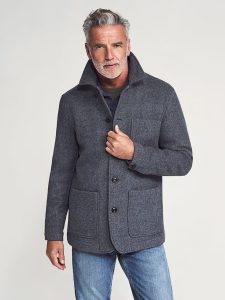
Well cut jeans or tailored trousers, quality knitwear or fitted shirts, a considered jacket. Nothing loud, but nothing careless either. The actor who looks composed in casual settings is the one who looks like they belong in serious work.
The Business Meeting Wardrobe
For meetings with producers, executives, agents and other industry professionals, a well cut blazer, quality shirt and tailored trousers reads correctly. A full suit is often too formal for these settings. The look should say that the actor takes the meeting seriously without appearing to be trying too hard.
Press Junkets and Interviews
Press appearances sit between casual and formal. The wardrobe needs to read well on camera, hold up through long days of back-to-back interviews, and reflect the actor’s personal identity without competing with the project being promoted.
Explore our custom suits to see the fabrics that photograph reliably on camera and the construction options that keep an actor looking sharp through a long day of press appearances.
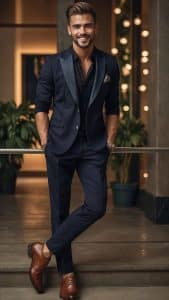
The red carpet is the highest-stakes wardrobe moment in an actor’s professional life. The photographs from a premiere or awards ceremony are seen by millions, published across the world, and remembered years later. The suit or tuxedo worn on the red carpet is doing serious work in the actor’s public identity.
Classic Formal
For most premieres and formal industry events, a well cut suit in a considered colour reads better than an outlandish statement piece. Deep navy, midnight blue, charcoal, or a soft grey depending on the event. Fabric with subtle sheen or texture catches red carpet lighting beautifully. The wardrobe should look considered rather than dramatic.
The Bespoke Tuxedo
For the highest-formality events (major awards, gala premieres, industry black-tie occasions), a properly cut bespoke tuxedo is essential. Peak or shawl lapel in silk satin, single-button front, quality patent shoes, a considered bow tie. Get this right and it will serve for years of formal events beyond the specific occasion it was ordered for.
Making It Personal
Personal expression on the red carpet is best delivered through details rather than through the overall silhouette. A distinctive lining chosen with meaning, a considered pocket square, unusual cufflinks, a fine watch. These details make the outfit yours without dating the garment or making it look like a costume.
The actors who become visually memorable are the ones whose wardrobe becomes recognisable across many appearances. Not because they wear the same outfit repeatedly, but because a consistent underlying identity holds together across many settings. A colour palette, a silhouette, a distinctive detail. Audiences learn to associate the look with the actor, and the look becomes part of the actor’s public brand.
Building this kind of signature style takes time and consistency. It usually starts with identifying what genuinely flatters the actor on camera, choosing a recurring element to anchor the wardrobe around, and repeating that element with small variations across appearances. Complete stylistic reinvention every event leaves the actor visually forgettable. Consistency, with small evolution, builds recognition.
For a serious actor, off-the-rack has significant limitations. The specific silhouette that defines a signature style is difficult to achieve within standard sizing, and the fit that reads as considered on camera requires garments built specifically for the wearer. Bespoke solves both. A tailor can build a suit around the exact cut the actor wants to become associated with, in the fabrics that photograph reliably, at the fit that reads correctly on screen.
For actors whose work involves frequent international travel between shoots, premieres and press appearances, working with a bespoke tailor who understands travel-friendly fabrics keeps a signature style intact across long flights and time zones.
Exclusive Tailor is one of the original bespoke tailoring houses of Patong, Phuket, founded by Johnny and Nitu and run as a family business ever since. Our clients in film, television and public life include actors, presenters, musicians and public figures whose work places them in front of cameras and audiences regularly. Many first met us during a Phuket visit and continue the relationship through our trunk show service in their home cities. Building a signature dressing style across a career rewards a long relationship with a bespoke tailor, and we take that relationship seriously across every stage of an actor’s professional life.
If you would like to explore building a wardrobe that carries you from audition to premiere, you can book a consultation at our Patong showroom or through our contact us page if you would prefer to be fitted in your home city. We work with actors, presenters and public figures on wardrobes that grow with a long career in front of the camera.
What should an actor wear to an audition?
Simple, well fitted and quietly considered. Dark jeans or tailored trousers, a fitted plain shirt in a neutral colour, well maintained shoes. If the role calls for a type, a soft nod in that direction is useful without being costume.
What should an actor wear on the red carpet?
A well cut suit in a considered colour or a properly cut bespoke tuxedo for the most formal events. Express personality through details such as lining, pocket square and accessories rather than through the overall silhouette.
How should actors dress for press junkets?
Well cut suits or considered separates in solid colours that photograph consistently on camera. Fabrics with subtle texture catch studio light better than flat cloth. Bespoke shirts that fit correctly at the collar are essential since the collar is what viewers see most closely.
Do actors need bespoke tailoring?
For a serious actor, yes. The specific silhouette that defines a signature style, and the fit that reads as considered on camera, both require garments built specifically for the wearer. Off-the-rack forces compromises that appear in every photograph.
How does an actor build a signature style?
Start with what genuinely flatters you on camera. Choose a recurring element (a colour palette, a silhouette, a distinctive detail) to anchor the wardrobe around, and repeat that element with small variations across appearances. Consistency builds recognition over a career.
How many pieces does an actor’s professional wardrobe need?
A working actor typically needs several bespoke suits, a properly cut tuxedo, a rotation of camera-ready shirts, and well chosen casual pieces for the public-casual settings that punctuate a career. Quality and consistency matter more than volume.


Mon-Sat 10:30 – 22:00
Sunday 16:00 – 22:00