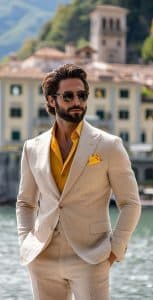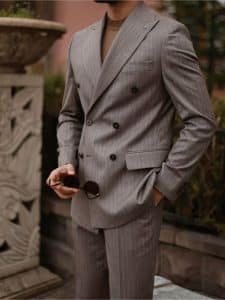
Most men who travel often own at least one suit they think of as their travel suit. The one that gets packed first, the one that comes out of the case and still looks presentable, the one that stops being a problem the moment the plane touches down. What very few of them realise is that the difference between an ordinary suit and a genuine travel suit comes down to perhaps half a dozen specific decisions made during the tailoring process. The suit that holds up around the world is not an accident. It is engineered.
This is a close look at what actually makes one suit a travel suit and another suit a problem on the road. Not a general wardrobe piece. A specific look at the fabric choice, the construction choice, the fit choice and the finishing choices that together produce a single garment capable of handling the frequent traveler’s week. If you only own one suit for international business travel, this is what it should be.
Of all the choices that go into a travel suit, the fabric decision is the one that does the most. Specifically, the choice of a high-twist worsted wool. The yarn in high-twist wool is spun with more turns per inch than ordinary worsted, which produces a fabric that resists creasing in a way standard wool simply cannot match. A frequent traveler in a high-twist suit arrives at the meeting looking different from a traveler in a conventional wool suit, and the difference is not subtle.
The specific weight matters too. For travel across varied climates — a London morning, a Singapore afternoon, a New York evening — a mid-weight high-twist wool handles the whole range without the traveler noticing the fabric is working. Lighter weights for warm-climate routes. Heavier only for consistently cold destinations.
When clients come to us as a bespoke tailor in Patong specifically for a travel suit, this is the conversation we have first. Not cut, not colour, not detailing. Which cloth is going to spend the next several years in and out of aircraft seats, and which cloth is going to let them walk off the plane looking considered.
Beyond the fabric, the way the jacket is constructed determines how it behaves after a flight. A fully canvassed or half-canvassed jacket (where the internal structure is natural canvas sewn to the cloth) recovers its shape far better than a fused jacket (where the structure is glued to the cloth). After hours of sitting, folding and movement, the canvassed jacket relaxes and returns to its line. The fused jacket often doesn’t.
The lining choice also matters more than most buyers realise. Silk or Bemberg lining slides over a shirt rather than catching, keeps the body cooler through warm arrival-city walks, and does not retain the smell of a long day in the way heavier synthetic linings sometimes do. These are small decisions. Together they produce a jacket that handles a week on the road without the traveler fighting it
A travel suit is cut slightly differently from a suit built only for conference rooms. Not loose, but with enough room for movement through airports, taxis and the specific contortions of airplane seats. The shoulder sits naturally rather than tightly. The chest closes without pulling when the arms are forward. The trouser rise sits comfortably through hours of sitting without the waistband becoming uncomfortable or the trouser line creasing badly.
Off-the-rack suits cannot deliver this. They are cut to averages, and the specific adjustments that make a suit genuinely wearable through a long day of travel are the kind of adjustments only a bespoke tailor can make around the individual wearer’s body and travel habits.
None of these details is dramatic on its own. Together they produce a garment that was clearly made with the traveler in mind.
A travel suit has to work across different formal expectations in different cities. A navy that reads as business-appropriate in London should also read as business-appropriate in Tokyo, New York and Dubai. Deep navy and mid-to-dark grey are the two colours that cross all serious business settings without needing adjustment. For a single travel suit, navy is almost always the right answer: it works for day meetings, evening client dinners, formal receptions and the specific middle-ground settings that come up in international business.
Patterns on a single travel suit should be subtle to invisible. A fine pinstripe, a quiet windowpane, or plain cloth. Bold patterns limit the suit’s usefulness across settings. Clients commissioning a travel suit through a best suit tailor in Phuket consultation usually arrive thinking about pattern more than they should and leave with a plain cloth because the versatility matters more than the character.
There is an argument some travelers make for owning several mediocre travel suits rather than one excellent one. In practice, the opposite is true. One well-made bespoke travel suit, worn in careful rotation, lasts years and holds its line throughout. The cost per wear becomes small. The reliability of knowing exactly what the suit will do in every setting is worth more than variety. And the fit, the cloth and the construction that make the travel suit worth its investment are not available at any price in off-the-rack.
For a frequent traveler, the sensible wardrobe is one travel suit of real quality plus a few supporting pieces (shirts, a second suit for days when the travel suit is being rested, perhaps a blazer). Not five mediocre suits in rotation. The one great suit does more work than the five.
Our workshop in Patong has been making wardrobes for international business travelers for decades. Johnny and Nitu built Exclusive Tailor as a family business long before most of our current clients were old enough to be putting miles on a passport, and the specific craft of travel-friendly tailoring has been one of our quiet specialisations for most of that time.
Clients fly in from Europe, the United States, Australia and across Asia, and many of them have been coming back for the next suit for ten or fifteen years. The suits they wear onto those flights are built with the flight in mind, which is why they still look like the suits they wore to the first meeting of the trip when they are walking into the last one.
If you travel often and would like to build a genuine travel suit, you can arrange a visit to our Patong showroom. We generally recommend starting with the fabric conversation and letting the rest of the suit be built around the cloth that is going to serve your specific travel patterns across the next several years.
What makes a suit a genuine travel suit?
Primarily the fabric. High-twist worsted wool resists creasing in a way standard wool cannot. Beyond the fabric, canvassed construction, silk or Bemberg lining, a cut that moves with the wearer, and travel-specific details such as trouser side adjusters all contribute.
What is high-twist wool?
Wool yarn spun with more turns per inch than standard worsted, producing a fabric that resists creasing and holds its line after hours of sitting. It is the single most important fabric choice for a travel suit.
Should a travel suit be lighter or heavier weight?
For most international travelers who cross varied climates, a mid-weight high-twist wool handles the full range without needing adjustment. Lighter weights suit consistently warm destinations; heavier weights suit consistently cold ones.
What colour should a travel suit be?
Deep navy for a single travel suit, because it works across every serious business setting worldwide. Mid grey is the strong second choice. For patterns, keep them subtle to invisible so the suit stays versatile across contexts.
Why not just buy several cheaper travel suits?
One well-made bespoke travel suit lasts years, holds its line through every flight, and costs less per wear than several mediocre suits that need replacing within a shorter cycle. The reliability of knowing exactly what the suit will do in every setting is also worth more than variety.
Do I need bespoke for a travel suit?
Yes. The specific adjustments that make a suit genuinely travel-friendly — the cut around the wearer’s actual body, the fabric and construction choices, the small travel-specific details — are not available at any price in off-the-rack. A bespoke travel suit does what off-the-rack simply cannot.


Mon-Sat 10:30 – 22:00
Sunday 16:00 – 22:00